Between Trucks. Delivering Results.
CASE STUDIES & SCENARIOS
Every cross-docking Platform installation starts with a specific operational problem. What follows are the scenarios we’ve solved, and the customers who can now serve markets they couldn’t reach before.
THREE INDUSTRIES. ONE OPERATIONAL NEED.
REFRIGERATED FOOD DISTRIBUTION
Urban Last-Mile Delivery
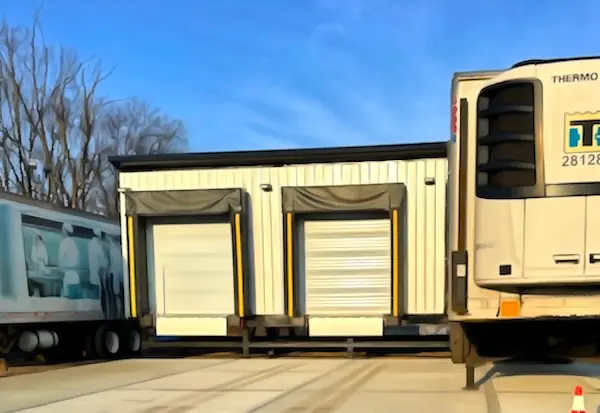
A man door, interior lighting, dusk-to-dawn solar exterior lighting, stairs, a Platform landing, and a connected ramp complete the installation. Multiple smaller vehicles, ranging from 17 to 28 feet and nimble enough for urban delivery routes, are loaded from the Platform for their daily runs.
The Platform is the hinge between long-haul inbound and last-mile outbound. It is portable. It is not a building. It required no construction permits beyond the electrical pull required to service the enclosure.
The operation now serves customers it could not previously reach.
Small operators who were buying from grocery stores or lesser distributors because no one else could get to them are now being served by a distributor with the scale and product range to meet their actual needs. The market expanded.
Competitors who were filling the gap by default lost ground they didn’t know was at risk.
CONSOLIDATED MOVING
The Multi-Stop Long-Haul Problem
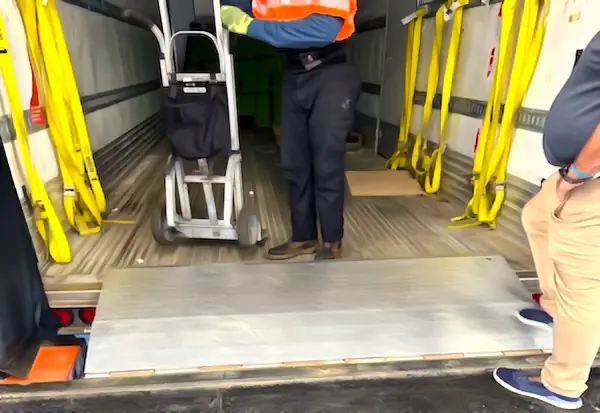
A residential moving operation picks up a partial load in Brooklyn. Another partial load six miles away. Neither alone fills a truck. Both need to reach Baltimore. The traditional solution is a holding facility, which means warehousing, dwell time, additional handling, and cost.
A cross-docking Platform positioned between the origin market and the destination city changes the equation. The consolidation truck picks up both Brooklyn loads and delivers to the cross-dock transfer point. From there, a direct outbound truck carries the consolidated load to Baltimore for final-mile delivery. No warehouse. No dwell. No double handling beyond the designed transfer.
RECYCLING & MATERIAL HANDLING
Staging as an Operational Tool
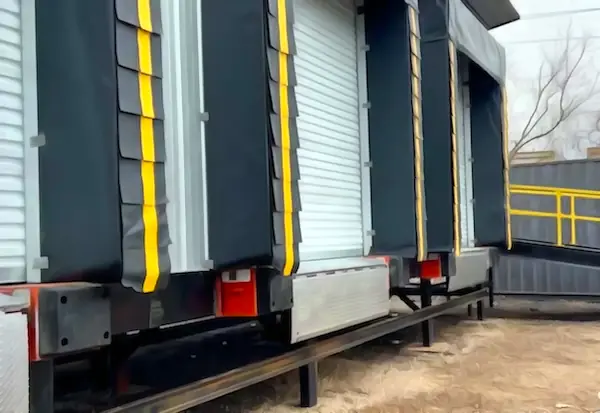
A high-volume recycler receives inbound trucks loaded with palletized bales of wire, copper tube, and mixed material streams.
Without a structured transfer and staging environment, the operation defaults to manual handling: dollies, pallet jacks, and labor-intensive sorting directly off truck beds. Slow, physically demanding, and operationally inefficient.
The Platform becomes a permanent operational tool, not a temporary workaround. A connected yard ramp gives equipment a clean path on and off the deck.
Safer working conditions. More efficient labor. A structured staging environment that brings order to a high-activity, high-variability inbound operation. The cross-dock Platform doesn’t just move material faster. It makes the people moving it safer in the process.